
Sri Lanka, being an island nation, is surrounded by abundant seawater but still faces challenges in ensuring a consistent and reliable freshwater supply. Rapid urbanization, seasonal rainfall variability, and increasing industrial demand have made Seawater Desalination an essential solution for strengthening long-term water security.
A modern seawater desalination plant converts seawater into potable and industrial-grade water, supporting municipalities, industries, and coastal communities. By adopting advanced Seawater Desalination Systems, Sri Lanka can ensure sustainable and large-scale Desalination for Water Supply.
Growing Need for Seawater Desalination in Sri Lanka
Freshwater availability in Sri Lanka is influenced by monsoon patterns and uneven distribution across regions. Coastal areas, in particular, face water scarcity despite being surrounded by seawater.
Key drivers for Desalination Plant adoption include:
- Increasing demand for clean water
- Seasonal water shortages
- Limited freshwater sources in coastal regions
- Growing industrial water requirements
- Need for climate-resilient water supply solutions
Implementing large-scale Seawater Desalination Systems helps reduce dependency on traditional water sources.
What is a seawater desalination plant?
A seawater desalination plant is a facility that removes salts, minerals, and impurities from seawater to produce usable freshwater.
These plants are widely used for:
- Municipal drinking water supply
- Industrial water requirements
- Power plants and utilities
- Coastal infrastructure development
Modern plants primarily use Seawater Reverse Osmosis Plant technology for efficient and reliable desalination.
How a Seawater Desalination System Works?
A typical Seawater Desalination System involves multiple stages to ensure effective purification.
-
Seawater Intake and Pre-Treatment
Raw seawater is collected and treated to remove:
- Suspended solids
- Marine organisms
- Organic matter
Pre-treatment includes screening, filtration, and chemical dosing to protect downstream systems.
-
Seawater Reverse Osmosis (SWRO)
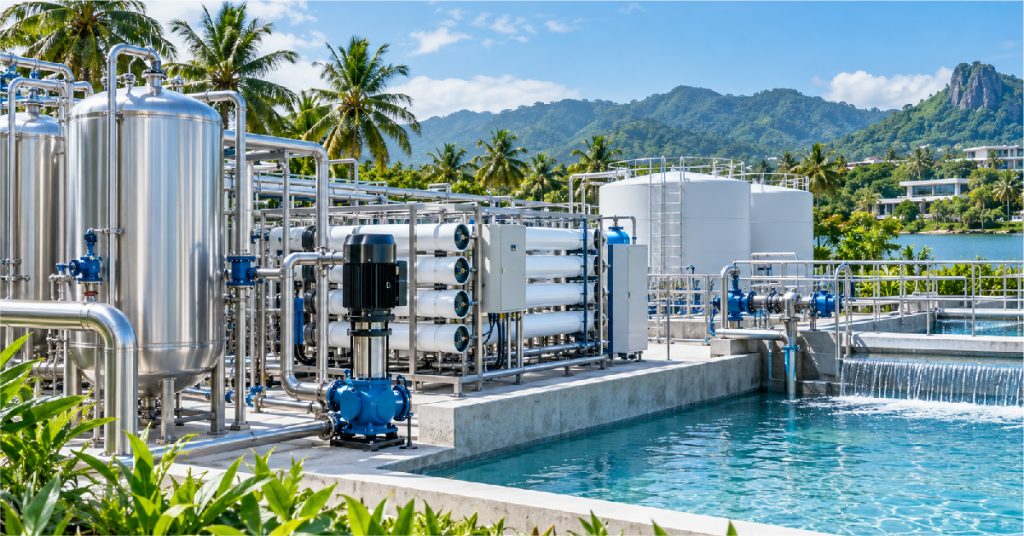
The core of a Seawater Reverse Osmosis Plant is the RO membrane system.
In this stage:
- High pressure forces seawater through membranes
- Salts and dissolved impurities are removed
- Freshwater (permeate) is produced
SWRO technology ensures high efficiency and consistent water quality.
-
Energy Recovery Systems
Desalination plants use energy recovery devices to reduce power consumption.
These systems improve efficiency by reusing pressure energy from rejected brine, making large-scale Industrial Desalination Plants more cost-effective.
-
Post-Treatment and Distribution
After RO treatment, water undergoes post-treatment to:
- Adjust pH levels
- Add minerals for stability
- Disinfect water
The treated water is then stored and distributed for use.
Types of Desalination Plants
-
Municipal Desalination Plant
Designed to supply drinking water to cities and communities.
-
Industrial Desalination Plant
Used by industries for process water, cooling, and utilities.
-
Hybrid Desalination Systems
Combine desalination with water recycling for improved efficiency.
These systems support both Desalination for Water Supply and industrial applications.
Benefits of Seawater Desalination Systems
Implementing a seawater desalination plant offers several advantages:
- Reliable water supply independent of rainfall
- Reduced pressure on freshwater resources
- Scalable solution for growing demand
- Suitable for coastal and industrial regions
- High-quality treated water output
- Supports long-term water security
Desalination plays a critical role in building resilient water infrastructure.
Applications in Sri Lanka
Seawater desalination is increasingly relevant in Sri Lanka for:
- Coastal city water supply
- Tourism and hospitality sector
- Industrial zones
- Power plants
- Infrastructure development projects
These applications make Seawater Desalination Systems essential for national water planning.
Ion Exchange Desalination Solutions
Ion Exchange, a leading company in the water treatment industry, offers a comprehensive range of products and solutions for desalination plants and wastewater treatment facilities. With over two decades of pioneering experience, Ion Exchange has anticipated the impending water scarcity by advocating for water recycling and integrating various separation processes, including physico-chemical, biological, and membrane methods, to maximize water recovery.
Recognizing the need for alternative water sources due to limited freshwater availability, Ion Exchange took a significant step in 1997 by commissioning India’s largest seawater reverse osmosis plant. Since then, the company has continued to develop and install large-capacity desalination plants for clients in India and abroad, providing sustainable solutions to the global water crisis.
Ion Exchange’s Innovative Product Range
Ion Exchange offers a diverse range of products and solutions for water treatment, including:
MEMBRANE SOLUTIONS
- Reverse Osmosis: Reverse osmosis (RO) is a technique that converts seawater into freshwater by forcing it through specialized membranes using unique filters. These membranes keep the salt out. RO is easy to expand for more water, and can use less power if we add energy-saving systems. But it’s important to clean the seawater first, so the filters work well. With energy-saving systems, we can use 30 to 40 percent less power. Therefore, reverse osmosis (RO) is an effective method for obtaining fresh water from seawater.
- Electrodialysis: Electrodialysis is a technology that employs specialized membranes and electricity to separate salts from seawater, serving purposes beyond producing drinking water. This process can also be utilized to produce salt, desalinate soy sauce, and recover valuable substances from saline wastewater. Therefore, its applications extend well beyond just drinking water, encompassing various other beneficial uses.
THERMAL SOLUTIONS
The thermal process mainly uses three different technologies: MSF, MED, and MVC. Their Thermal Power JV between NTPC and TNEB boasts a capacity of 19.8 MLD for 3 x 500 MW units. All three processes are equipped with condenser tube bundles, which are energy-efficient and adaptable to different heat sources.
- Multi-Stage Flash Evaporation (MSF): MSF involves heating seawater in successive stages to evaporate water and collect distilled water. It operates at a higher temperature range of 90 to 110°C.
- Multi-Effect Distillation (MED): MED employs multiple evaporation stages at reduced temperatures to minimize energy consumption. It is highly reliable, adaptable, and has low maintenance costs.
- Mechanical Vapor Compression (MVC): MVC relies on compressing vapor to evaporate water, making it a reliable and simple-to-operate technology.
These products are designed to meet the varying needs of desalination plants and other water treatment facilities, ensuring a reliable supply of clean water. In addition to these technologies, their Oil & Gas plant has a capacity of 26.4 MLD, their ceramics plant has a capacity of 1.5 MLD, and their fertilizer plants have a capacity of 40 MLD.
Supporting Sustainable Water Supply in Sri Lanka
As water demand continues to grow, Desalination for Water Supply will become a key component of Sri Lanka’s water infrastructure strategy.
Advanced desalination systems help:
- Ensure continuous water availability
- Reduce dependence on rainfall
- Support industrial and urban growth
- Improve resilience to climate change
By integrating desalination with modern water management practices, Sri Lanka can secure its future water needs.
Conclusion
A modern seawater desalination plant provides a reliable and sustainable solution for large-scale water supply in Sri Lanka. With advanced Seawater Reverse Osmosis Plant technology and efficient Seawater Desalination Systems, industries and municipalities can meet increasing water demand while protecting natural resources.
Desalination is no longer an alternative—it is a critical solution for ensuring long-term water security.
FAQs
- What is a seawater desalination plant?
A seawater desalination plant removes salts and impurities from seawater to produce freshwater for drinking and industrial use. - How does a seawater reverse osmosis plant work?
A seawater reverse osmosis plant uses high-pressure membranes to separate salts and contaminants, producing clean water. - Why is desalination important for coastal regions?
Desalination provides a reliable water source independent of rainfall, making it ideal for coastal and water-scarce regions. - What are the main benefits of seawater desalination systems?
They ensure a continuous water supply, reduce freshwater dependency, and provide high-quality treated water. - How does Ion Exchange support desalination projects?
Ion Exchange provides advanced desalination plants, membrane technologies, and integrated systems for large-scale water supply and industrial use.